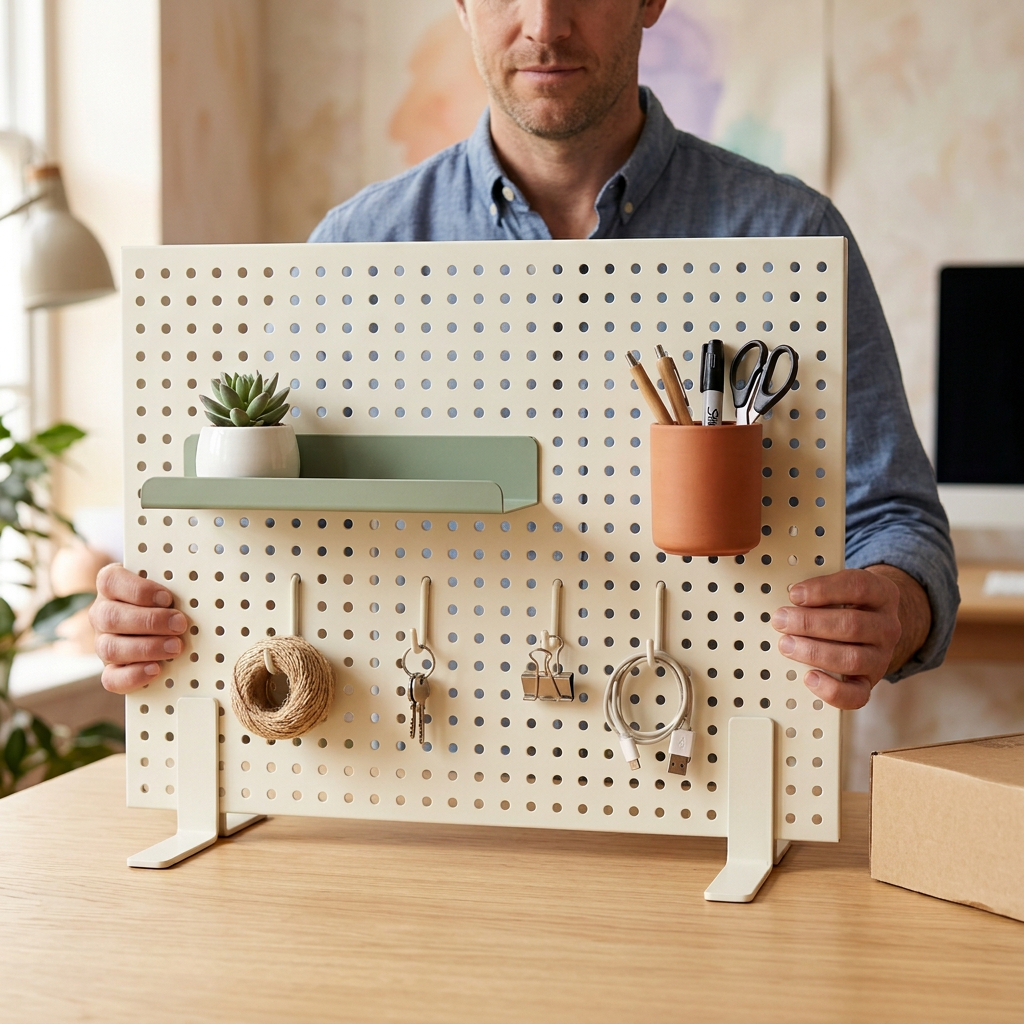
Desktop Pegboard Organizer System — Ivory Display Panel with Sage Shelf, Terracotta Pen Cup & Repositionable Hook Concept
Desktop Pegboard Organizer System — Ivory Display Panel with Sage Shelf, Terracotta Pen Cup & Repositionable Hook Concept
Made in the USA
Made to meet high U.S. quality standards.
Fast & Reliable Shipping
Ships within 24 hours with tracking updates.
180-Day Money-Back Guarantee
Not satisfied? Get a full refund within 180 days.
Visible Anti-Aging Benefits
Helps Reduce Wrinkles, Fine Lines & Puffiness
Gentle on Skin
Designed for a comfortable skincare experience.
Fast, Lasting Results
See visible results in as little as 7 days.
Couldn't load pickup availability

Product development draft: This is a proposed product design and copy draft, not a verified supplier specification. Images have not yet been generated. Dimensions, materials, mounting system, accessory quantities, hole pattern, attachment security and load ratings require physical-sample verification before publication.
🧱 Build a Small Landscape Above the Desk
Look at the objects you reach for most often. A pen lies beside the notebook. A small accessory moves between the keyboard and the edge of the table. A useful tool disappears beneath loose papers. Instead of adding another tray to the same surface, this desktop pegboard concept proposes a more vertical arrangement.
The design direction combines an ivory perforated panel with a sage shelf, a terracotta pen cup and matching hooks. The board becomes a visual framework, while the accessories create specific places for selected objects. The purpose is not to fill every opening. It is to make a small, deliberate arrangement that reflects the way you use your desk.
The Layout Workshop
Start with an Empty Board
Before planning accessory positions, list the few things that genuinely need to remain within reach. A board crowded with rarely used objects can become another form of clutter. Choose a small working collection first and keep long-term storage elsewhere.
The proposed ivory background gives the arrangement a lighter appearance and leaves room for richer colors around it. Its final width, height and hole spacing are not yet specified. Do not estimate usable capacity from the product name or the planned visuals.
Choose an Anchor
The sage shelf is intended as the main horizontal element. Its design direction is a shallow ledge with a raised front edge, suitable only for items that fall within the finished shelf's dimensions and approved load. The contrast between the pale panel and green ledge gives the layout a clear starting point.
A shelf on a vertical board is not automatically suitable for a phone, tablet, plant pot or heavy container. The attachment method, front lip, usable depth and load distribution must be checked using the real product. No charging, device support or spill-containment function is promised.
Add a Daily-Use Station
The terracotta pen cup introduces an upright container for compatible dry stationery. Its proposed warm color marks it out from the board without needing a printed label. Place only appropriate supplies in the finished cup and keep their combined weight within its verified limit.
Depth and opening size determine what fits. A short pencil and a long pair of scissors have different balance and access requirements, so the cup should not be described as universal tool storage. It is not intended as a drink holder, vase or food-contact container in this draft.
Leave Space Between the Hooks
Hooks create a different kind of storage point, but they need clearance around the item being hung. Plan the full shape of that item, not only the location of the hook itself. Keep hanging objects away from the keyboard area and any place where they could catch a sleeve or interfere with normal movement.
The proposed hooks are repositionable only as a design intention. Their locking method, removal process and resistance to accidental lift-out require testing. No specific number, shape or load rating is confirmed yet.
🪄 Arrange by Reach, Not by Symmetry
A balanced photograph and a useful working layout are not always the same thing. The accessory you use most often may belong toward one side, while a less-used object can sit farther away. Consider the seated position, monitor location and normal hand movements before deciding where anything goes.
Imagine a planning session with a notebook open in front of you. A pen returns to the cup, a small approved accessory rests on the ledge and the main writing surface stays available. The board is a background to the task, rather than another object that needs constant rearranging.
Later, your working tools may change. A genuinely reconfigurable system would let you reassess the layout, but only within the attachment pattern and instructions of the finished product. Do not promise compatibility with other pegboard brands or third-party hooks without checking the actual dimensions and mechanism.
The Part Behind the Display
A desktop board needs a verified support system. Freestanding feet, desk clamps and wall mounts are different installation approaches, with different space and safety requirements. This draft does not choose or certify a final mounting method; that decision must follow the actual supplied product.
- Confirm whether the board stands on the desk, clamps to it or requires another approved installation.
- Check the overall footprint, including supports and projecting accessories.
- Measure clearance behind the board and above the highest stored item.
- Review desk material and thickness requirements if clamps are supplied.
- Verify the total load and each accessory's individual limit.
- Check that the arrangement remains stable under approved use.
No no-drill, tool-free, damage-free or universal desk-fit claim is made. Installation hardware, fasteners and protective contact pads must be confirmed from the supplier's packing list and instructions.
A Palette with More Than One Mood
Ivory keeps the panel visually quiet. Sage adds a cooler horizontal accent, while terracotta warms the cup area. The planned photography can introduce peach, lavender and teal around this core palette without changing the product colors between images.
In a restrained office, pair the board with cream stationery and pale wood. In a creative workspace, repeat a small amount of terracotta or sage elsewhere on the desk to connect the arrangement. Actual colors, finish texture and material composition remain unverified.
🪴 Keep Some of the Board Empty
An unused opening is not wasted space. Leaving a margin around accessories can make individual objects easier to identify and help you see whether the arrangement has become crowded. Review the board as your routine changes rather than adding another hook every time a new item appears.
The concept offers a way to organize selected objects vertically, not a guarantee of greater productivity or a substitute for secure storage. Open shelves and hooks do not protect confidential documents or valuable equipment against theft, dust or accidental impact.
The Proposed Package Direction
The intended set includes an ivory pegboard panel, a sage shelf, a terracotta stationery cup and hooks, packed in a plain unprinted kraft box without a logo. Exact quantities, mounting supports, fasteners, tools and assembly requirements are not confirmed. They must be specified before the product is offered for sale.
Stationery, devices, notebooks, plants and furniture used in future scene photography will be styling props unless the verified packing list explicitly includes them. Do not imply that a decorated board arrives with every displayed object.
What the Sample Must Establish
Confirm panel dimensions, material, edge finish, hole shape and spacing, support construction, accessory attachments, approved positions and tested loads. Check whether accessories require locking parts or retainers. Verify cleaning guidance for the actual coating and avoid describing the board as waterproof, rust-proof, magnetic or scratch-proof without evidence.
Future images should show the same approved board, accessories, colors and unbranded packaging in every view. A complete ten-image set remains pending. The finished page should use those images to illustrate verified details rather than turn design intentions into performance claims.
The design starts with a simple question: which few objects deserve a place above the desk? With a verified support system and suitable accessories, a considered answer can turn an empty panel into a personal working arrangement.