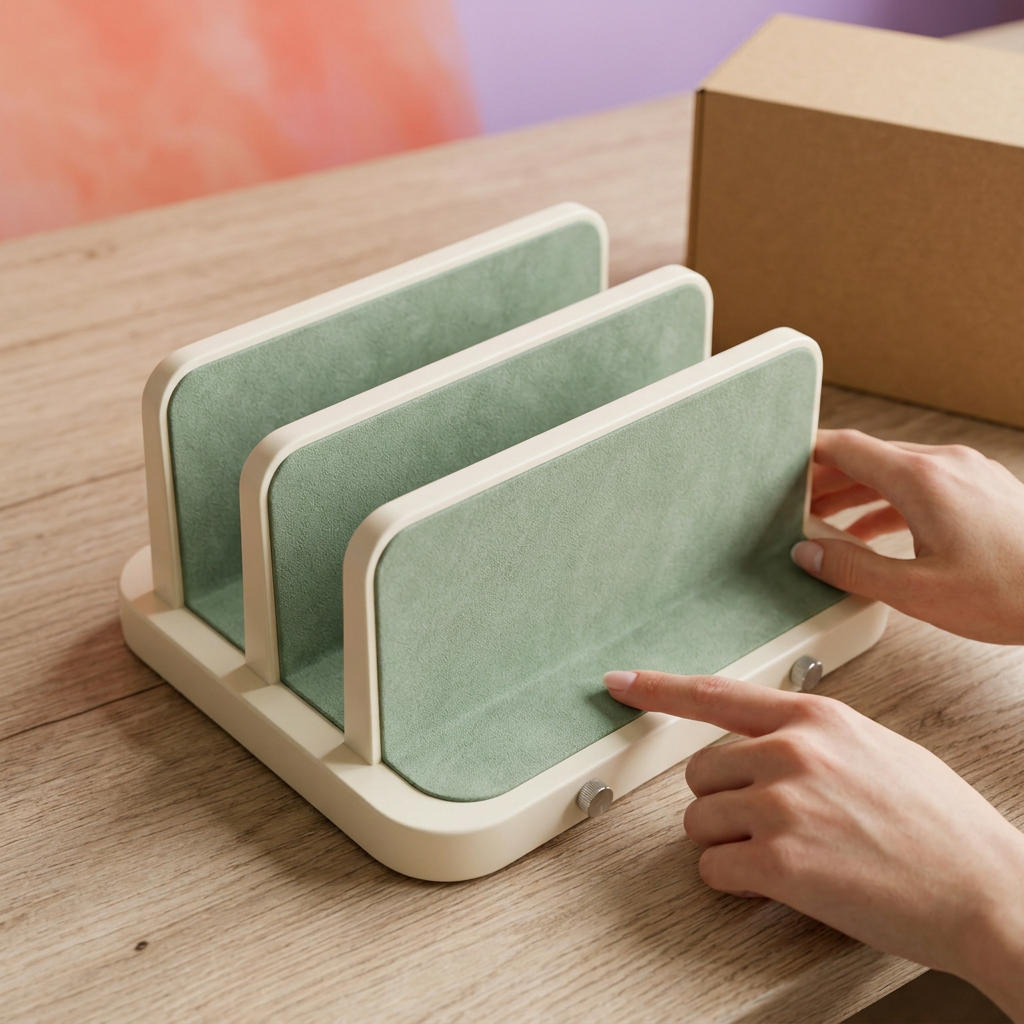
Dual-Slot Vertical Laptop & Tablet Storage Rack with Ivory Frame, Sage Contact Liners & Adjustable-Width Design
Dual-Slot Vertical Laptop & Tablet Storage Rack with Ivory Frame, Sage Contact Liners & Adjustable-Width Design
Made in the USA
Made to meet high U.S. quality standards.
Fast & Reliable Shipping
Ships within 24 hours with tracking updates.
180-Day Money-Back Guarantee
Not satisfied? Get a full refund within 180 days.
Visible Anti-Aging Benefits
Helps Reduce Wrinkles, Fine Lines & Puffiness
Gentle on Skin
Designed for a comfortable skincare experience.
Fast, Lasting Results
See visible results in as little as 7 days.
Couldn't load pickup availability

Product development draft: Images are AI-generated concept visuals. Slot dimensions, adjustment mechanism, materials, liner composition, device compatibility, stability and load limits require supplier and physical-sample verification before publication. Device scenes are illustrative, not verified operating or placement instructions.
💻 Where Does Your Laptop Go When You Are Not Using It?
Not every device needs to stay open across the desk all day. A second laptop may be waiting for the next task. A tablet may be finished with its reference document. Sometimes the most useful addition to a workspace is not another screen position, but a defined place for the equipment that is temporarily out of use.
This vertical storage rack concept explores that role with two proposed device channels in one low base. Warm ivory framing and sage contact surfaces give it a softer appearance than a bare equipment bracket. The intention is a dedicated parking place for compatible closed laptops and tablets, subject to verification of the finished product and the equipment being stored.
A Storage Decision in Four Parts
Keep / The Devices That Belong Within Reach
Start by deciding which devices actually need a place on the desk. A daily laptop and an occasionally used tablet may have a different storage routine from spare electronics that belong in a cabinet. A two-slot design is not an invitation to stack several devices into each opening.
The proposed use is one compatible device per approved slot. Actual capacity depends on tested load, device dimensions, balance and the final instructions. No simultaneous two-device load rating is confirmed by the generated images.
Turn / Consider the Footprint Differently
A closed laptop placed flat occupies an area roughly defined by its lid. A compatible device stored upright changes that arrangement, leaving a different footprint to plan around. The rack itself still needs space, and the devices extend above it, so vertical does not mean space-free.
Allow clear room to lift a device in and out without striking a shelf, monitor or nearby object. Keep the rack away from the desk edge and normal chair movement. Its final stability must be assessed with the intended devices, not inferred from a wide-looking base.
Separate / Give Each Device a Channel
Three upright divider plates define the proposed pair of open-top channels. The plates have rounded rectangular silhouettes and an ivory border around broad sage-colored faces. This repeated shape creates a clear visual rhythm: a divider, a gap, a divider, another gap and a final divider.
The contact surfaces are shown with a soft-looking texture. They are intended as a lining concept, not proof of a particular cushioning material. Silicone, felt, foam, anti-static performance and scratch prevention must not be claimed without verification.
Return / Make Putting It Away Part of the Routine
Imagine closing a task, disconnecting the equipment as appropriate and returning a compatible device to its designated slot. The center of the desk becomes available for a notebook or the next project without placing another computer on top of the first one.
A storage routine works best when the placement is deliberate and easy to check. Support the device while inserting or removing it, avoid forcing it between dividers and follow the final product instructions. Do not carry the rack while it is loaded.
🧱 Anatomy of the Proposed Rack
The low rounded rectangular base visually anchors the upright plates. Its ivory finish repeats around each divider, while sage appears across the broad contact faces and lower channel surfaces. The contrast makes the storage channels easier to distinguish in the empty product views.
Two small silver knobs are shown along the front of the base as part of the adjustable-width design direction. Their appearance does not validate how the dividers move, which parts are adjustable or how the setting locks. Those details need a real mechanism, a specified range and clear operating instructions.
No minimum or maximum slot width is supplied in this draft. Do not tighten a divider against a device as if it were a clamp. Adjustment should only be performed according to the verified instructions, with the device removed unless those instructions explicitly state otherwise.
Match the Device, Not Just the Category
The words laptop and tablet cover many shapes. A thick protective case, a raised hinge, a curved underside or a protruding button can change the way a device sits. Even two computers with the same screen diagonal may have different weight distribution and edge profiles.
- Measure the device thickness with its usual case or cover fitted.
- Check the final usable channel width and divider height.
- Confirm the approved device orientation and contact points.
- Compare individual and combined weights with the tested load limits.
- Check that vents, buttons, hinges and connectors remain unobstructed.
- Allow clearance for removal without pulling on attached cables.
No brand-specific compatibility, universal fit or supported screen-size range is promised. The finished sample should be tested with the actual equipment before a compatibility list is added to the page.
Storage Is Not a Docking Station
This concept is a passive organizer. It does not charge devices, connect a display, transfer data or supply power. There are no proposed charging ports, wireless coils, magnetic locks or integrated cable connections.
Operating a laptop with the lid closed or in a vertical orientation depends on the computer manufacturer's requirements. This rack does not establish that such operation is supported. The use scenes are intended to communicate storage; do not advertise active closed-lid operation, improved cooling or thermal protection without separate evidence.
For storage, follow the device manufacturer's guidance on shutdown, sleep, temperature and orientation. Do not place hot equipment into an arrangement that obstructs required airflow. The rack's lining is not a verified heat barrier.
🍃 A Softer Home for Technical Objects
Ivory and sage create a restrained frame around silver or dark devices. Against pale wood, the combination feels light and natural. With peach or lavender desk accents, it becomes part of a richer color palette without competing with the rest of the workspace.
The images show a matte-looking finish and textured green faces. These are visual details of the concept, not confirmed surface specifications. Check the actual sample under normal room lighting before matching other accessories to its color.
The Quiet End of a Work Session
A desk does not have to display every device at once. Picture finishing with a tablet, closing its cover if appropriate and returning it to a verified slot. The device remains easy to identify, but it no longer shares the exact area needed for writing or typing.
That is the central idea: not hiding equipment, but giving it a different state between tasks. The rack is a proposed parking place, not a security product, protective case or guarantee against drops.
Package and Care Notes
The intended package contains one ivory-and-sage dual-slot rack in a plain, unprinted kraft box without a logo. Laptops, tablets, cases, charging cables, plants and furniture shown in the images are not included. Confirm whether tools, spare liners or assembly hardware are supplied before promising them.
Cleaning guidance must match the final base, dividers, coating and lining. Do not assume removable or washable liners, water resistance or compatibility with solvents. Inspect the contact surfaces and remove trapped debris as directed by the final care instructions before placing devices in the rack.
Before This Concept Becomes a Product Page
Verify the assembled measurements, base weight, channel dimensions, adjustment process, lock security, liner material, individual and combined load limits and device fit. Confirm the real packing list and approved storage orientations. Replace any concept scene that differs from the final product or the supported way of using it.
With those details established, the design has a simple story to tell: two defined spaces for compatible devices, one coordinated base and a desk that can change between screen work and everything else you do there.